When the Ministry of Education unveiled the National Education Policy (NEP) 2020 mandating coding from Grade 6 onwards, Indian schools reacted in two distinctly divergent ways. The first group purchased expensive third-party software licenses that locked students into cartoonish drag-and-drop block interfaces through Grade 9. The second group attempted to teach college-level C++ or Java syntax without foundational scaffolding, intimidating young learners and overwhelming non-specialist computer teachers. In response, many edtech providers swung to the opposite extreme: teaching Python exclusively, ignoring board requirements and broader computing paradigms.
Today, six years after NEP 2020's announcement, the consensus from school principals, board examiners, and industry leaders is unequivocal: Confining students to a single language like Python leaves critical pedagogical and academic gaps. A forward-looking school curriculum must be polyglot — strategically introducing multiple programming languages mapped to developmental stages, board syllabi, and practical engineering skills.
Curriculum Takeaways
- Board-Syllabus Alignment: Guaranteed coverage of ICSE Java (BlueJ OOP), CBSE Python & C++, and vocational Web Tech.
- Zero Installation Multi-Compiler: In-browser sandboxes allow students to compile Python, Java, C++, and Web without IT friction.
- Tangible Robotics & Full-Stack: Connecting code to physical sensors, motors, and deployed web apps makes abstract algorithms come alive.
Why a Polyglot Multi-Language Curriculum is Essential for Modern Schools
Different programming languages cultivate different mental models of computation. A single-language curriculum simply cannot prepare students for both rigorous board examinations and versatile modern technology careers:
- Python (AI, Data Science & Algorithmic Prototyping): High readability mimicking natural English allows 11-year-olds to grasp variables, loops, and conditional branches effortlessly. Python also provides an uninterrupted bridge to CBSE Data Science, Pandas, NumPy, and Machine Learning in senior classes.
- Java (ICSE/ISC Board Standard & Enterprise OOP): The mandatory programming language for ICSE Classes 9–10 (Computer Applications) and ISC Classes 11–12 (Computer Science). Learning Java ensures students master class definitions, object instantiation, method overloading, and encapsulation strictly per BlueJ and Council standards.
- C++ (CBSE Computer Science, DSA & Competitive Programming):** Blazing execution speed, pointer arithmetic, memory management, and the Standard Template Library (STL). The foundational language of coding Olympiads (IOI/ZIO) and high-performance systems engineering.
- HTML5, CSS3 & JavaScript (Full-Stack Web Engineering): The interactive backbone of the internet. Empowers students to build tangible, live websites and browser applications they can showcase to parents, universities, and peers worldwide.
- Arduino C (Embedded Systems & Robotics): Connects software logic directly to sensors, motors, microcontrollers, and IoT hardware, transforming lines of code into physical movement.
The Rigalma K-12 Progressive Curriculum Roadmap
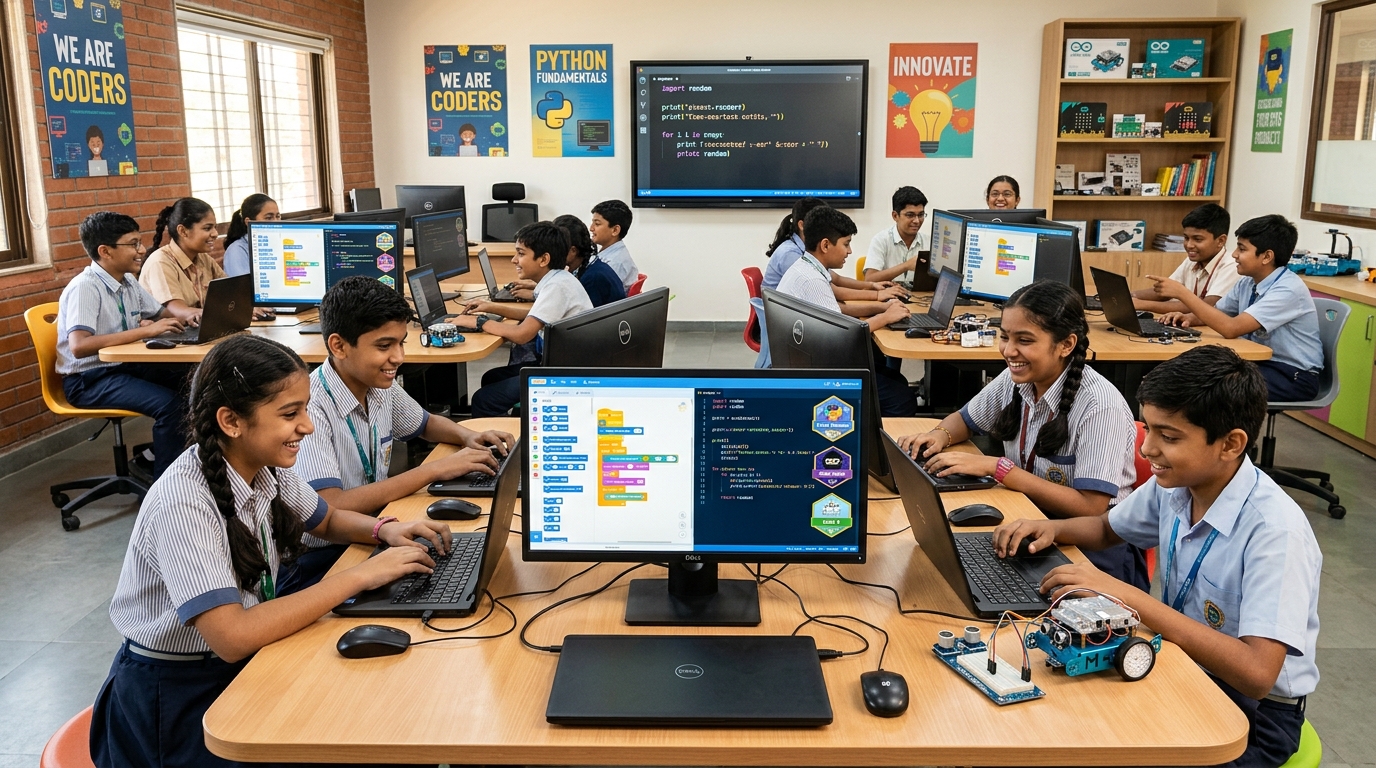
Rather than treating coding as a disconnected hobby class, Rigalma integrates coding into the regular school timetable with an age-appropriate 3-stage continuum:
| Age Band | Core Focus Areas | Languages & Tools | Student Milestone Capstone |
|---|---|---|---|
| Primary (Grades 1–5) | Algorithmic thinking, pattern recognition, spatial navigation, sequencing | Scratch, Blockly, Codeable Puzzles, Tangible Robotics | Interactive animated storybook & maze-solving game |
| Middle School (Grades 6–8) | Text-based syntax, variables, conditional logic, loops, functions, lists | Python Fundamentals, Turtle Graphics, HTML5 / CSS3 | Text adventure game, interactive quiz, personal student portfolio website |
| Senior School (Grades 9–12) | Object-oriented programming, data structures, board curricula, REST APIs, AI foundations | Java (ICSE BlueJ), Python (CBSE), C++ (DSA), JavaScript, SQL Databases, OpenCV, IoT Microcontrollers | Full ICSE Java program, full-stack web application, AI computer vision app, or IoT campus weather station |
"Our computer teachers were initially apprehensive about covering multiple languages like Java and C++. Rigalma's structured lesson slides, zero-installation browser IDE, and automated AI mentors gave our faculty complete confidence. Now our ICSE students ace their Java practicals while middle schoolers build Python data models and web applications." — Sunita Mukherjee, Head of Computer Science, Heritage International School
Solving the Computer Lab IT Nightmare
The single biggest barrier to coding education in Indian schools is lab hardware fragmentation. Some schools possess older desktop towers running Windows 7 or 10; others have Linux labs, while newer institutions adopt Chromebooks. Traditional software setups require installing separate Java JDKs, configuring C++ GCC PATH variables, maintaining Python virtual environments, and updating browser libraries.
Rigalma solves this completely with our Zero-Installation Multi-Language Web IDE:
- Multi-Compiler Sandbox in Any Browser: Runs Python 3.11, Java JDK 17, GCC C++20, and Node.js/V8 inside Chrome, Edge, Safari, or Firefox.
- Cloud-sandboxed execution: Students write code across any language, click "Run Code", and observe instant compiled console output and visual DOM rendering.
- Teacher Homework Portal: Students can continue their multi-language coding assignments from home on family laptops or tablets with automated code grading.

About the Author: Pooja Kulkarni
Pooja heads STEM & Coding Education at Rigalma. An ex-software engineer and curriculum architect, she has designed computer science textbooks and trained over 1,200 school teachers across India on modern coding pedagogy.
Bring Rigalma's K-12 Coding Program to Your School
Request curriculum blueprints, sample student textbooks, and an interactive demonstration of our in-browser coding IDE.
Related Articles in Rigalma Knowledge Hub
 Academics X AI
How PYQ Analysis is Revolutionizing Board Exam Prep
Discover how 10-year trend analysis saves hours during revision season.
Read Deep Dive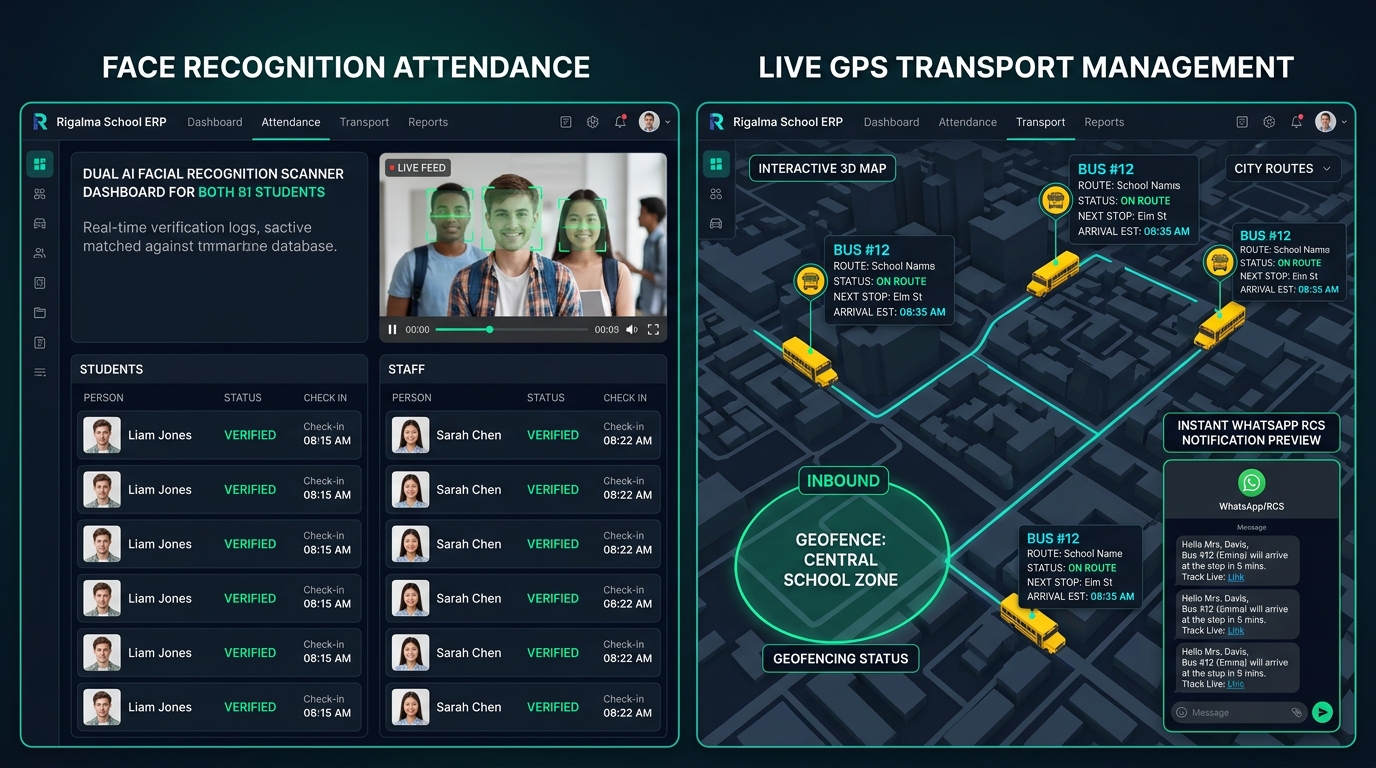 ERP Tech
Why Schools are Switching to Touchless Face Attendance
Explore the speed, hygiene, and anti-proxy advantages of AI facial scanners.
Read Tech Guide